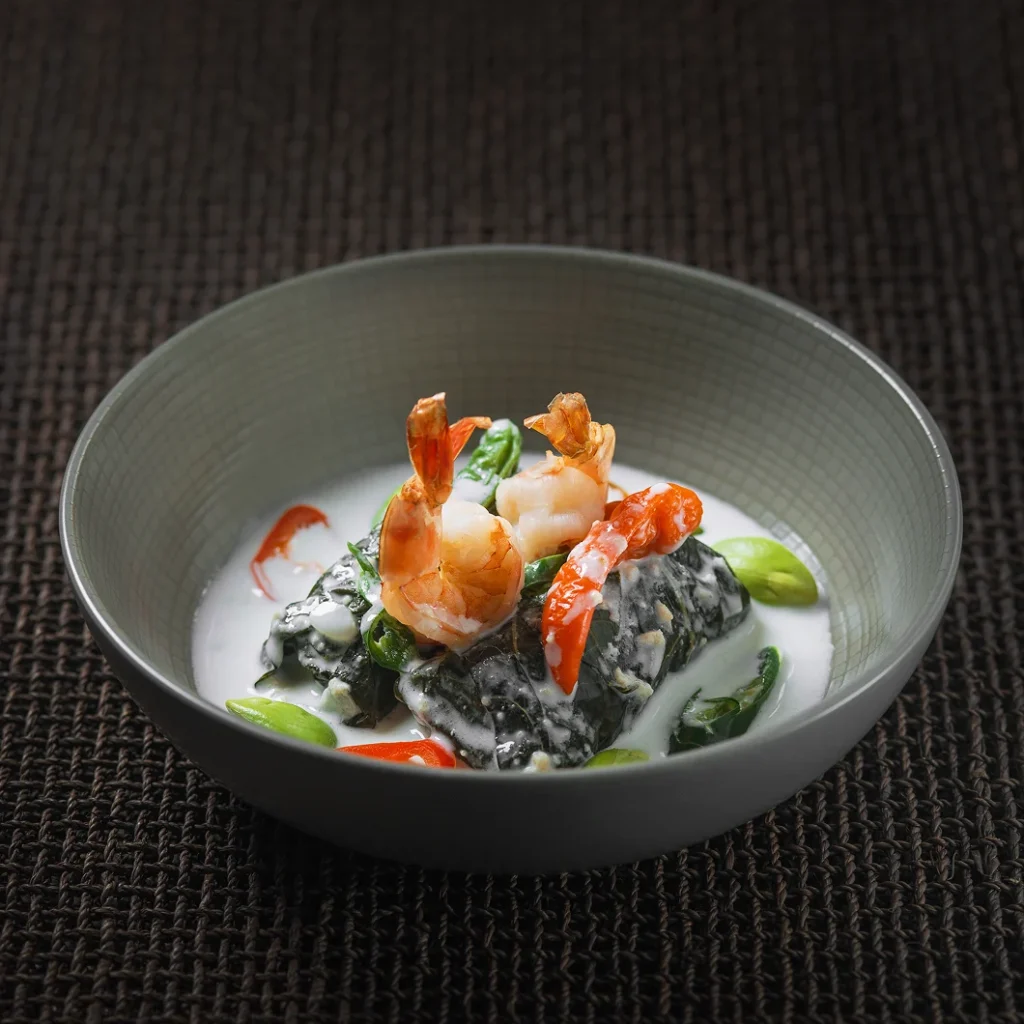
The practice of wrapping food in leaves is common throughout Indonesia. Banana, teak, and bamboo have all long served the purpose, and for generations cooks across the archipelago have reached for whatever grew close at hand. The tradition takes many regional forms: pepes in Java, lemang in Sumatra, burasa in Sulawesi, tum in Bali.
In nearly all of these dishes, however, the leaf is only an instrument. It gives the food its shape and holds in the steam and fragrance as it cooks, then arrives at the table as a neat parcel. Once opened, the leaves are set aside and discarded, and only the filling is eaten.
Buntil stands apart from the rest. A speciality of Central Java, Buntil consists of grated coconut, teri (small dried anchovies), and spices bound inside a papaya leaf. The wrapper is not removed before eating; it is part of the dish. In buntil, the wrapping becomes part of the meal itself.
The name is thought to derive from mbuntel, or menguntel-untel, meaning to wrap or to bundle. The attribution should be treated with some caution: no written source supports it, and it belongs more properly to folk etymology than to documented history.
At Sasanti, we make a single alteration to the traditional preparation. In place of teri, our buntil is filled with salmon. This is sometimes read as an attempt to refine the dish, to lend Indonesian cooking a more “elite” character. That is not our intention. We consider Indonesian food to be already possessed of great complexity. Our reasoning is more practical: teri is a dried fish with a high histamine content, capable of provoking a reaction even in guests who have no allergy to fish. Salmon allows a greater number of guests to enjoy the dish without concern.
Such a change sits easily within tradition, since the filling of buntil has never been settled . It varies from region to region and from household to household, according to what is available and who is at the stove. Salmon is simply the latest addition to a long lineage.
We hope this change of filling does not alter the identity of buntil, for its filling has always varied according to the region in which it is served